

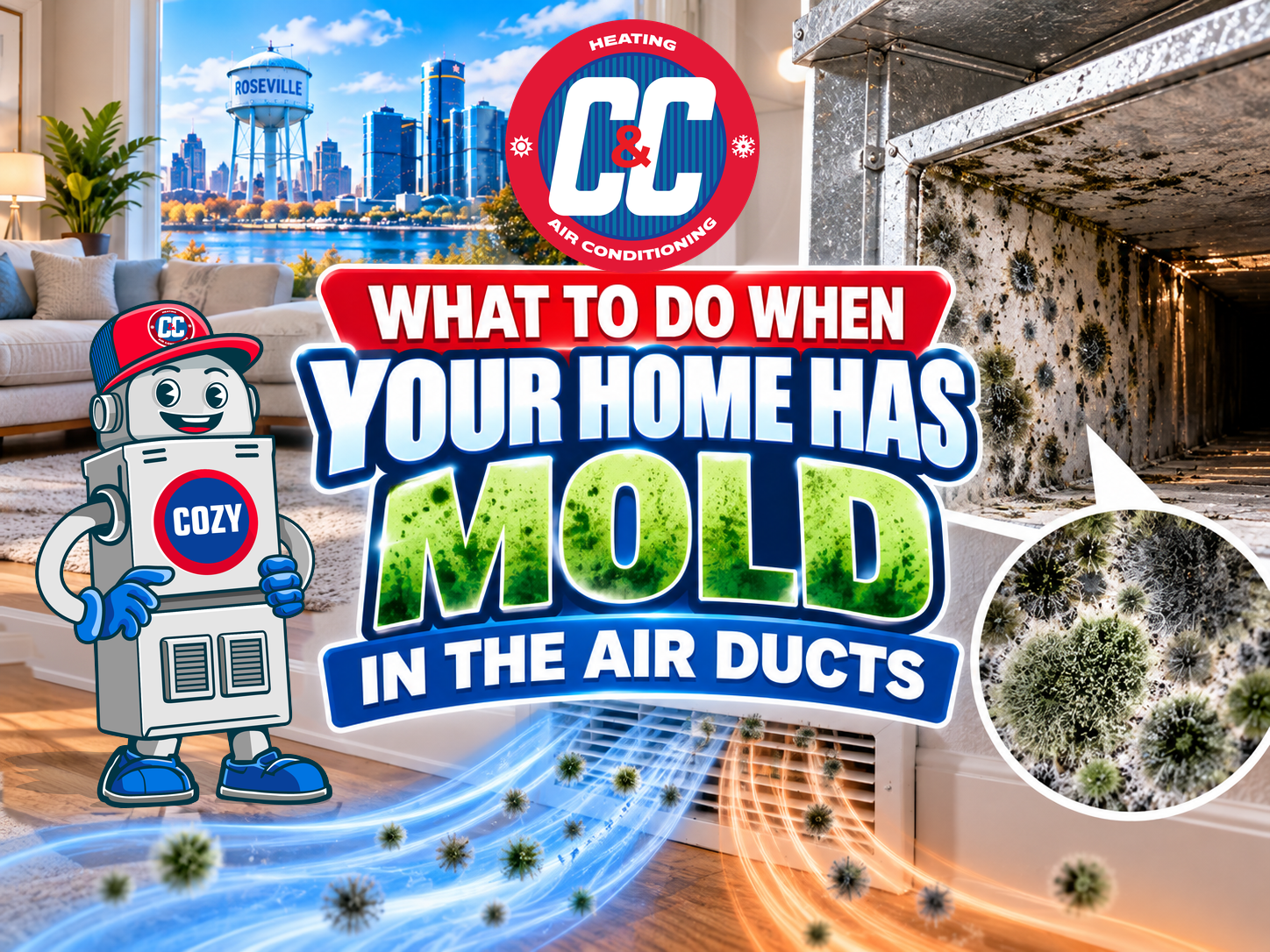
Mold loves moisture, and unfortunately, your HVAC system and ductwork can sometimes provide the perfect home. Excess moisture, condensation, and leaks all create conditions that allow mold in your air ducts to grow and thrive.
Humid Michigan summers and damp basements make this a common problem in Roseville and across Macomb County. Here’s what causes it, how to spot it, and what to do about it.
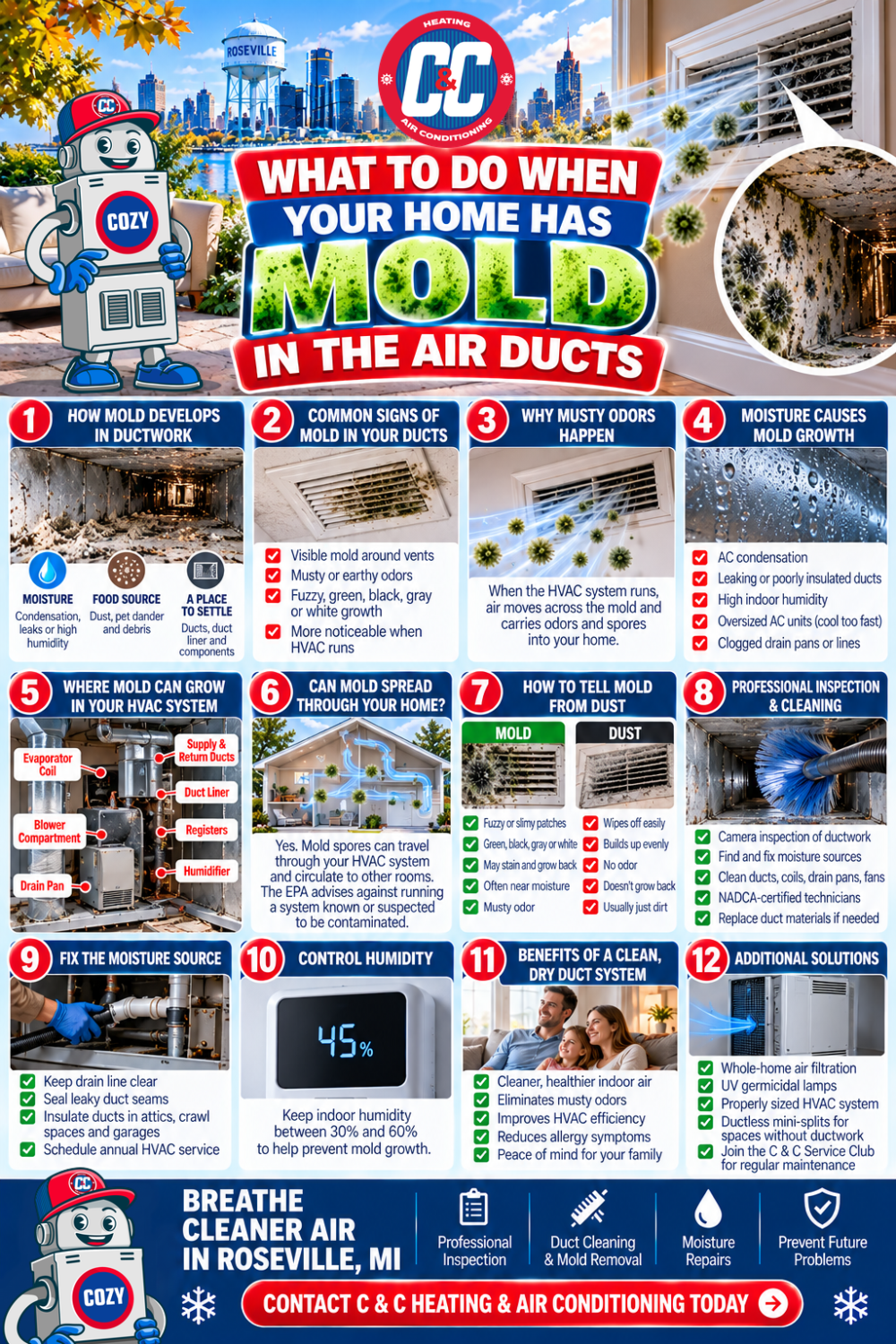
How Mold Can Develop Inside HVAC Ductwork
Mold needs moisture, a food source, and a place to settle. Dust, pet dander,r and debris inside ducts supply the food, while condensation, leaks, or high humidity supply the moisture.
Sheet metal ductwork and fiberglass duct liner and duct board are not immune. If there is moisture in the metal ductwork, settling dust allows for mold to grow, and fiberglass is a porous material that traps dust and holds moisture, providing ideal growth conditions.
Signs There May Be Mold in Your Air Ducts
Possible warning signs of mold in your ductwork are visible growth around vents, registers,s or accessible HVAC components, or a persistent musty or earthy odor when your HVAC is running.
Mold inside ducts usually looks like fuzzy, velvety, or slimy patches in black, green, gray, or white. It grows in spots or clusters, often near seams, low points,s and areas close to the air conditioner. Mold around air vents in Roseville tends to appear on the back of the grille or the immediate surface around it.
Why Musty Odors Often Appear When the HVAC System Runs
When the system is off, any odors from mold in the ductwork stay trapped inside the ducts. Once the blower starts, air moves across the growth as it pushes into your rooms, resulting in the musty smell from the vents in your Roseville, MI, home.
If it returns with every cycle, it can point to mold in your furnace ducts or mold in your AC ducts and should be checked.
How Moisture and Condensation Encourage Mold Growth
Finding air duct mold in Roseville, MI, is only half the story. The bigger question is, why is it growing?
The U.S. Environmental Protection Agency (EPA) says the key to controlling mold is controlling moisture. Condensation around supply vents, for example, encourages growth. When cold air from your AC flows through a vent, the metal cover gets cold, and on humid days, moisture in the room air condenses on the cold surface, collecting on the vent and the ceiling around it.
An oversized air conditioner makes the problem worse because it cools the house so fast it shuts off before it can pull much moisture out of the air, leaving rooms cool but damp and making condensation more likely.
Where Mold Can Grow Inside an HVAC System
HVAC mold usually grows where water collects or air moves slowly. Common spots include the evaporator coil, drain pan, blower compartment, duct liner, supply and return ducts, registers, and whole-home humidifiers.
Why Leaking or Poorly Insulated Ductwork Can Create Moisture Problems
Ductwork needs care and attention so it doesn’t strain other parts of your heating and cooling systems. If your ducts have gaps or loose joints, they’ll pull in air from around the outside of the duct. If the gaps are in a damp basement, that wet, musty air will be pulled into your system.
Ducts in hot, humid spaces can also get wet if they aren’t wrapped in insulation, causing air duct moisture problems along the whole length of the duct.
Can Mold Spread Through Your Home’s HVAC System?
Mold can spread through your HVAC system when air moves over or through contaminated areas, carrying mold spores into other parts of your home. For that reason, EPA guidance advises against running an HVAC system known or suspected to be contaminated with mold. Replacing the air filter may capture some airborne particles, but it won’t address mold growing on the coil, blower, or duct walls.
Mold involving an HVAC system can be more complicated than a small, visible patch on a hard, accessible household surface, as most ductwork is out of reach. Scrubbing reachable ductwork can release spores, which is why existing growth needs professional mold removal, and you should schedule an air duct inspection in Roseville as soon as you can.
How to Tell Mold From Dust Around Air Vents
Dark streaks on the ceiling around a supply vent are often just dirt left behind by moving air. Dust wipes off easily and builds up evenly. Mold in air vents in Roseville is more likely to stain, grow back in patches or appear alongside moisture, rust, or a musty odor.
Mold around your vents may have spread from the ductwork, much of which is behind walls, floors, and ceilings, and needs a professional camera inspection to see inside. At C & C Heating & Air Conditioning, we’ll show you the mold before providing you with a quote for ductwork mold removal in your Roseville home.
Why the Evaporator Coil and Drain Pan Should Be Checked
When your air conditioner runs, it pulls water out of the air inside your home. That water drips into a pan inside the unit and drains away through a small pipe. A clogged drain pipe or a cracked or overflowing pan is a common cause of mold in HVAC systems in Roseville and requires HVAC mold removal by a Roseville professional.
What Happens During an HVAC and Ductwork Inspection?
If you have mold in the air ducts of your Roseville home, the technicians at C & C Heating & Air Conditioning start with a careful inspection, using cameras to see deep inside your ducts.
We handle air duct moisture problems across Roseville, MI, by tracking down where the moisture is coming from, and we’ll also check the parts of your system where water collects. These include the cooling coil, drain pan, drain line, blower, filter, supply and return ducts, duct insulation, vents, and any whole-home humidifier.
If cleaning is needed, our NADCA-certified team handles air duct cleaning with professional equipment, and we’ll also clean the coils, drain pans, fans, vents, and registers, so mold has fewer places to hide.
When Moldy Duct Materials May Need Replacement
Homeowners should consider air duct cleaning in Roseville when there is substantial visible mold growth inside hard-surface ducts or on other HVAC components. If insulated ductwork becomes wet and moldy, the insulation may need to be removed and replaced because it cannot be effectively cleaned.
Once your ducts and duct materials have been addressed, consider products like whole-home air filtration and UV germicidal lamps to help prevent sickness by improving the indoor air quality in your Roseville, MI, home.
Why Removing Mold Without Fixing the Moisture Source Does Not Solve the Problem
Mold often returns after ductwork is cleaned because the moisture issue hasn’t been dealt with. Routine duct cleaning removes dust and debris, but won’t prevent mold growth without additional remediation.
The source of the moisture needs to be identified and corrected. Otherwise, your efforts at air duct mold removal will be unsuccessful, and the mold may stage an unwanted comeback tour later.
How Humidity Control Helps Reduce Future Mold Growth
Keeping the indoor relative humidity between 30% and 60% helps reduce the likelihood of mold in the ductwork of your Roseville property. Dehumidifiers can help.
How to Help Keep Your HVAC System and Ductwork Dry
To help prevent HVAC mold in Roseville, keep water out of your system by:
- Keeping the condensate drain clear.
- Sealing leaky duct seams.
- Insulating ducts that run through attics, crawl spaces, and garages.
- Scheduling annual servicing.
Members of our C & C Service Club get two free precision tune-ups each year for their furnace, air conditioner, and humidifier, as well as priority service and discounts.
Some spaces are hard to serve with ductwork, like sunrooms, additions, and older homes. A ductless mini-split system heats and cools these rooms with no ducts to worry about at all.
Address Ductwork Mold and Moisture With C & C Heating & Air Conditioning
At C & C Heating & Air Conditioning, we specialize in handling Metro Detroit mold in ductwork problems from inspection to repair.
We’ve provided Oakland, Wayne, and Macomb County air duct mold removal since 1948, and we invite you to check out some of our recent projects. Our trained technicians are available seven days a week for moisture repairs and duct cleaning in Roseville and throughout the area. With a 4.9 star rating from over 7,000 reviews, we’re here to help keep your heating and cooling system working properly.
Do you need home duct cleaning in Metro Detroit? Contact C & C Heating & Air Conditioning today to schedule installation, repair, or maintenance services and ask about Energy Star Rebates available to you!