


As the weather gets more humid during the summer months, most homeowners believe that turning on their air conditioning will completely reduce the humidity in their homes. While it is true that running your AC will remove some humidity as a byproduct of cooling, it isn’t designed to eliminate all the moisture from the air.
Indoor humidity can affect your health, energy bills, and even the condition of your home. When humidity levels are too high or too low, you may notice problems that go far beyond feeling uncomfortable. At C & C Heating & Air Conditioning, we resolve common Michigan home humidity problems. If you have high indoor humidity, or if your air is too dry, we can help.
What Is Indoor Relative Humidity?
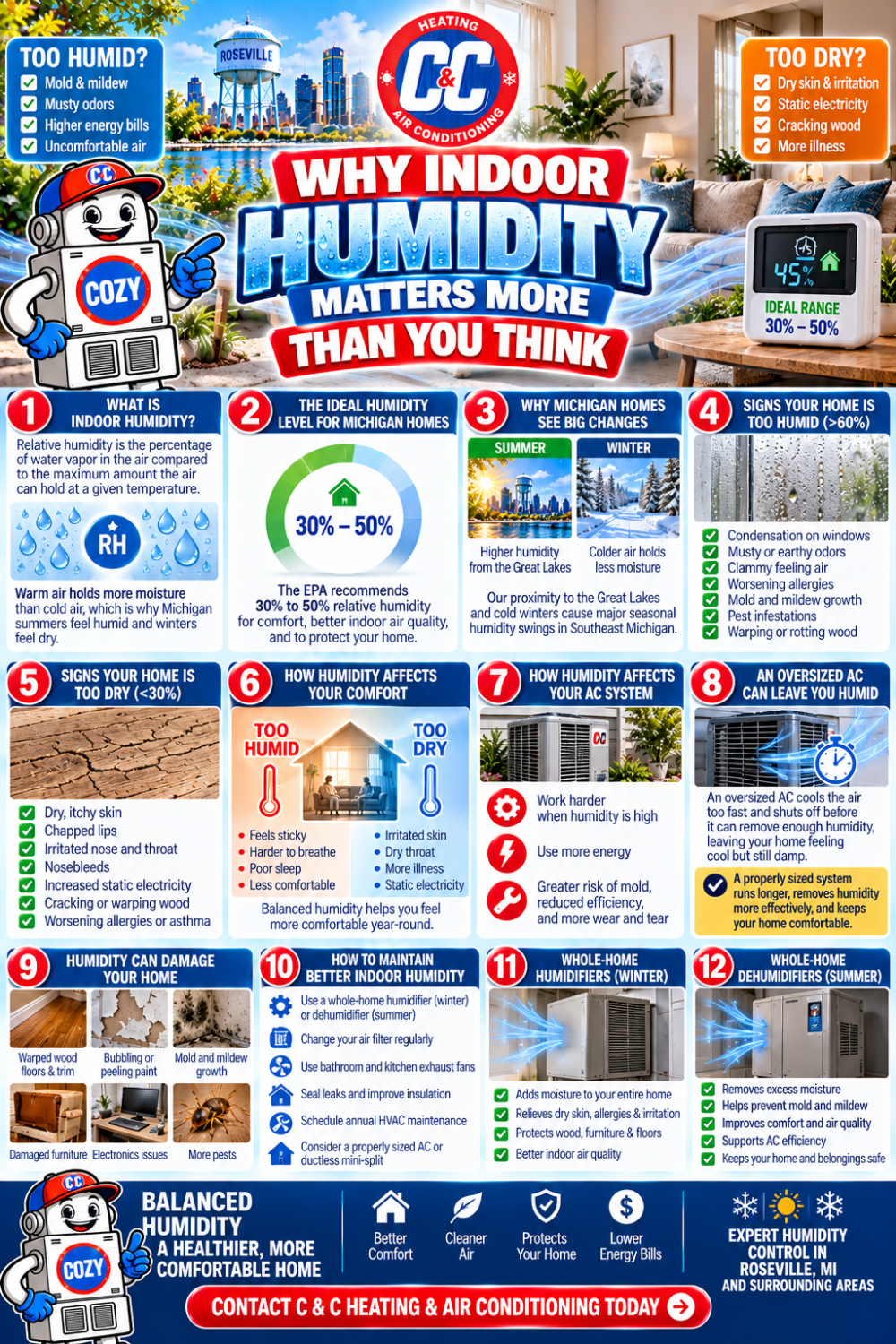
Indoor relative humidity is the percentage of water vapor in the air, in relation to the maximum amount of water the air is able to hold at a certain temperature. Warm air holds more moisture than cold air, which is why Macomb County homes can feel heavy or sticky in the summer, then switch to uncomfortably dry in the winter.
At C & C Heating & Air Conditioning, our technicians provide options for HVAC humidity control in Roseville, MI, including both humidifiers and dehumidifiers, as well as HVAC tune-ups that’ll help maintain consistent comfort.
What Is the Right Humidity Level for a Michigan Home?
The U.S. Environmental Protection Agency (EPA) recommends maintaining indoor humidity levels between 30% and 50% for optimal indoor air quality and comfort. At this ideal indoor humidity, Michigan residents will feel more comfortable while protecting their home from unnecessary damage related to moisture or dryness.
You can check the humidity of your home with a hygrometer. This is a digital device that measures the amount of water vapor in the air and provides an accurate relative humidity percentage. Even your home thermostat can read humidity, although it may not be as accurate.
You don’t need fancy equipment to know if your house feels uncomfortable. If you notice signs your home’s humidity isn’t right, contact us for professional humidity control in Roseville.
Why Michigan Homes Experience Major Seasonal Humidity Changes
In your home, issues like leaky ductwork, poor air sealing, and lack of bathroom and kitchen exhaust fans can affect the humidity. Humidity will rise after doing laundry, showering, cooking, or doing other activities that release steam or water into the air. You may also notice the humidity in your basement is higher because it’s surrounded by porous concrete, with limited airflow and proximity to moisture from the soil.
The Detroit, Michigan area is especially affected by seasonal humidity changes. This is because of our proximity to the Great Lakes, which add heavy moisture into the summer air, and because our winters are so cold that the air cannot hold onto the humidity, affecting the indoor air quality of Roseville, MI, homeowners.
Signs Your Home Has Too Much Indoor Humidity
In homes with high indoor humidity, Roseville, MI, residents may notice signs like:
- Condensation or frost on the windows.
- Respiratory irritation and worsening allergies.
- Musty or “earthy” odors.
- Clammy-feeling air.
If your home has over 60% humidity indoors, we recommend a high-quality dehumidifier, not only to improve your comfort, but also to prevent damage to your home, such as:
- Mold growth, as damp spaces are breeding grounds for mold and mildew.
- Pest infestations, as certain insects and rodents prefer a moist environment.
- Structural damage like warping or rotting wood.
Signs the Air in Your Home Is Too Dry
The low winter humidity levels in Michigan cause dry indoor air in Roseville, MI, especially when your furnace is cycling more dry air in and heating it. Some signs your air is too dry are:
- Increased static electricity due to a buildup of electrical charge that accumulates when there’s a lack of moisture.
- Cracking or warping wood trim and floors.
- Worsening allergies or asthma.
How High Humidity Changes the Way Your Home Feels
When it’s humid, your body cannot properly cool itself because the sweat does not evaporate as efficiently from your skin. This makes you feel sticky and can make breathing feel more difficult, or “heavier”. Even if the air is cool in your home, if the humidity is high, you’ll feel a difference.
How Low Humidity Affects Winter Comfort
When you have low humidity in your house in Roseville, MI, you may experience:
- Dry, itchy, or cracking skin.
- Chapped lips.
- Irritated nose and throat.
- Nosebleeds.
- Coughing.
Maintaining the ideal indoor humidity with professional humidity control will restore moisture to your air in the winter, so you can feel better.
How Humidity Affects Your Air Conditioner
Air conditioners and ductless mini-splits both have to work harder when home humidity is high. This puts extra wear and tear on your home’s cooling system, while using more energy than necessary. There is also a greater risk of mold and mildew growth inside the AC.
Along with installing a whole-home dehumidifier to reduce the ambient humidity in your home, it’s also important to keep up with your air conditioner maintenance. Dirty evaporator coils, dirty air filters, and low refrigerant can make your AC’s humidity control less effective against the average Michigan indoor humidity levels.
Why an Oversized AC Can Leave Your Home Feeling Humid
If your AC is running but there’s still high humidity in the house in Roseville, it could be due to poor maintenance, or it might be that the air conditioner is too big for your home.
When an AC’s too big, it cools the air down too fast, then shuts off before it can decrease home humidity. Roseville, MI, residents with ACs that short-cycle like this may want to consider replacing the system with one more appropriately sized for their space.
How Humidity Can Affect Wood, Paint, and Other Materials in Your Home
A humid house in the summer in Roseville, MI, can be damaged by the moisture, which can cause wood floors, furniture, and trim to warp or swell. Wallpaper and paint may bubble and peel, and excessive moisture can also affect your electronics over time.
How Excess Moisture Creates Conditions for Mold and Mildew
The high summer humidity levels in Michigan create the ideal environment for mold and mildew to thrive. If you notice discolored patches on walls, ceilings, or floors, or if your home smells musty during humid weather, it’s likely due to these common fungi. Air filtration and UV lights in the HVAC system can help, but if you have moist air and condensation, mold spores are more likely to grow.
Whole-Home Humidifiers for Michigan Winters
A whole-home humidifier is a specialized device that is installed directly in your HVAC system, adding excellent Macomb County humidity control on those dry winter days. These are recommended over portable humidifiers when you want to add moisture to the entire house, not just a single room.
A qualified C&C Heating & Cooling technician will install your whole-home humidifier in your Roseville, MI, home with expert care, so you can enjoy the best in Macomb County humidity control.
Whole-Home Dehumidifiers for Humid Michigan Summers
When we install a whole-house dehumidifier in a Southeast Michigan home, we centrally install the unit, connecting it directly to your heating and cooling system. This allows the unit to remove moisture from the air before it’s redistributed around the house.
How C & C Heating & Air Conditioning Can Help Balance Indoor Humidity
To provide balanced indoor humidity, we take a holistic approach, checking everything from your AC’s evaporator coil to looking for duct leaks. We install systems that automatically detect moisture levels, and we ensure you have proper ventilation. We also provide tips to homeowners for consistently reducing humid air in the house.
C&C Heating & Air is known for our high-quality Metro Detroit indoor humidity control systems. We’ve been trusted in your area for decades, earning excellent reviews from local clients.
Take Control of Indoor Humidity With C & C Heating & Air Conditioning
At C & C Heating & Air Conditioning, we understand that humidity control is an essential part of your HVAC system. Our professional solutions include whole-house humidifiers in Southeast Michigan and whole-home dehumidifiers. Roseville, MI residents who need help improving comfort and efficiency in your home, contact our team to schedule an appointment and ask about Energy Star Rebates available to you!